
 2 posts
0Project families
0Blog posts
0Years building
0Industries
Major Projects
Bigger builds that combine several subject areas. Pick a family to jump into its write-ups.
2 posts
 4 posts
Smart Home
 6 posts
Atom
 5 posts
Electronics Workbench
 4 posts
Buggy
 2 posts
Industrial Projects
 3 posts
Solar Projects
 2 posts
Hand Activity Recognition
 4 posts
iamJohnnySam.com
 4 posts
Electronics
 2 posts
Weather Detector
 1 post
NFC Invitations
 1 post
Workout Optimizing
 1 post
Excel Projects
Latest Posts
Showing 8 of 74 posts, newest first.
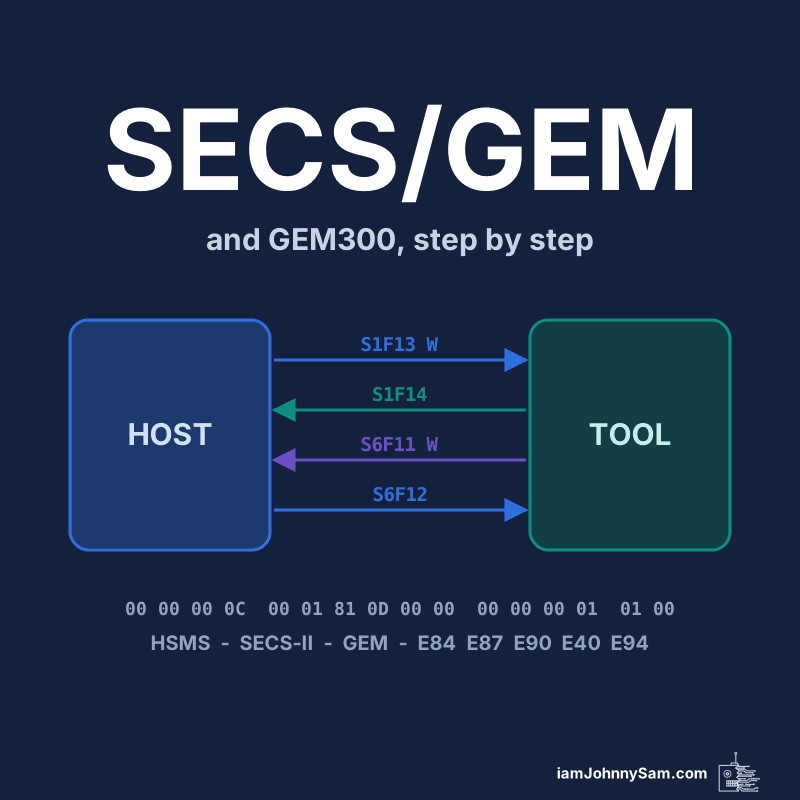
SECS/GEM and GEM300, Step by Step
How semiconductor tools talk to the factory, from the wire up: HSMS framing and timers, SECS-II items, GEM states, reports and remote commands, then the 300 mm standards (E84, E87, E90, E40, E94) and how they hand off to each other for one FOUP from arrival to departure. With state machine diagrams and a working C# host and equipment sample. A living post that grows as I read more of the standards.
semiconductor Read more
Flow: A Configuration-Driven Tool Controller for Robots, Stations and Payloads
Flow is a tool controller I am building from scratch: it owns the state of a whole tool, moves payloads between robots and stations, and drives every device from configuration alone. This post walks through the equipment and software modules, the single native executable and statechart engine, permits and staged transfers, the event-sourced Core, configured recovery, booting the tool, two sample tools, routes and jobs, the deadlock check and timing model, sequences, the dispatcher, cycle runs and dry run, an aligner simulator, and Flow UI and the Launcher, along with what went wrong on the way. Flow is still in development, and this post is updated as each milestone lands.
C# Read more

Payback of Solar Investment (Sri Lanka): One Year In
An 8.33 kWp rooftop system in Borella cost LKR 1,403,435.95 in July 2025. Fourteen months of inverter data and CEB bills, and what they say about when it pays itself back.
solar Read more
Semi Catalog 2026
Every exhibitor at nine SEMICON shows in 2026 and four 2025 editions, plus the SEMI member directory, merged into one catalog of 6,791 companies and sorted into suppliers, customers and the wider ecosystem from the point of view of a semiconductor equipment builder.
semiconductor Read more
Website Overhaul, Three Years Later: Git, an API and Running It From Tower
What changed on iamJohnnySam.com since the 2023 SQL and PHP overhaul: version control, a REST API, redesigns, a gated CV, the secrets mistakes, and moving publishing into Tower.
php Read more
Atom: The Home Server That Runs the House
An overview of Atom, a 2010 Core i5 desktop turned home server: storage and Samba, the Jellyfin and MediaBox media stack, Tower as the control plane, FinanceTracker and other personal apps, Pi-hole and Tailscale, and the smart-home devices it drives — with links to every post in the project.
home server Read more
Tower Part 3: It Started Learning the House
Two months after Part 2, Tower moved from the inbox to the building: LAN loop detection after a real outage, a Wi-Fi topology map, AC infrared learned locally and derived for every temperature, energy and climate per room, a self-labelling CCTV classifier, a to-scale house schematic, and a 6x cut in idle CPU.
C# Read more
Tower Part 2: The Dashboard Started Reading My Email
Six weeks after the first Tower post, the home server dashboard stopped just watching things and started doing work: Gmail importers that file 12 years of bills and bank statements into FinanceTracker, solar yield tracked against Colombo irradiance, rclone backups to Dropbox and a UUID-pinned drive, smart-home automations and an encrypted secrets vault.
C# Read more